
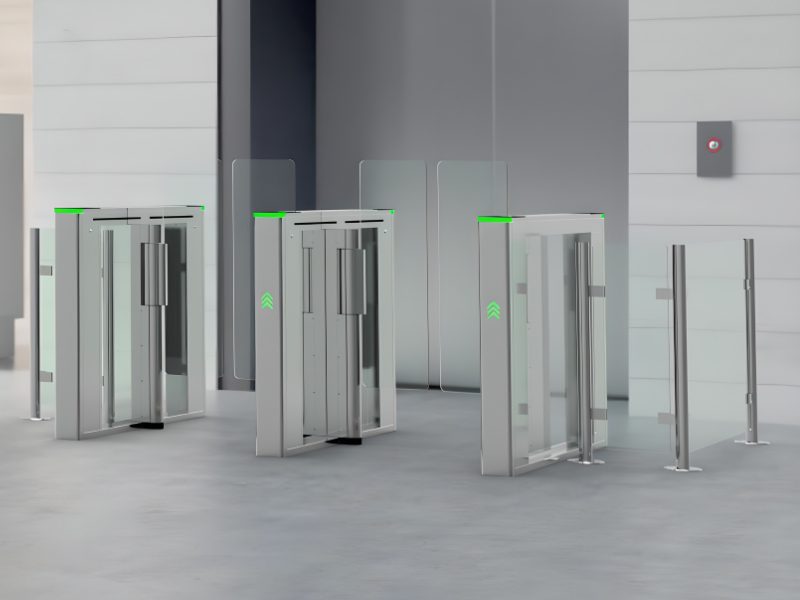
Speed gates and turnstiles are both used to control pedestrian access, but they work in different ways and suit different types of sites.
Speed gates are often used in modern reception areas where appearance and quick movement matter. Turnstiles are usually chosen where a site needs a stronger physical barrier and controlled one-person entry.
The right option depends on your building, security requirements, foot traffic, budget and how the entrance needs to look.
What are speed gates?
Speed gates are automated entrance control systems. They usually use moving glass barriers that open when access is approved.
A user presents an approved credential, such as an RFID card, key fob, QR code or biometric reader. Once the system approves access, the barriers open and allow the user through.
Speed gates are commonly used in:
- Corporate offices
- Airports and VIP lounges
- Government buildings
- High-tech facilities
- Premium commercial receptions
Their main advantage is speed. The barriers open and close quickly, helping people move through busy entrances without relying on manual checks for every user.
They are also well suited to buildings where design matters. With glass panels and a cleaner finish, speed gates can fit neatly into modern reception areas and commercial interiors.
What are turnstiles?
Turnstiles are physical entrance control systems that allow one person through at a time.
They are often used where a site needs a more robust way to manage pedestrian movement. Different types are available, including tripod turnstiles, full-height turnstiles and glass pass turnstiles.
Tripod turnstiles use three rotating arms to control entry. Full-height turnstiles provide a stronger physical barrier, making them suitable for higher-security or more functional environments. Glass pass turnstiles offer a more visually considered option while still managing access.
Turnstiles are commonly used in:
- Stadiums and arenas
- Public transport hubs
- Amusement parks
- Factories and industrial sites
- High-footfall locations with stricter entry requirements
They are known for durability and controlled movement, particularly in busy settings where appearance may be less of a priority than strength and reliability.
Key differences between speed gates and turnstiles
The clearest difference is how each system balances flow, appearance and physical control.
Speed gates are usually faster. Their automated barriers help authorised users move through efficiently, making them a good fit for busy offices, commercial receptions and premium facilities.
Turnstiles provide more controlled individual entry. They can be slower than speed gates, but they make it clear that one person should pass through at a time. Full-height turnstiles also offer a stronger physical barrier than most speed gate systems.
Appearance is another consideration. Speed gates tend to look more modern, with glass panels and streamlined cabinets. Turnstiles are often more practical in appearance, although glass pass options can create a cleaner finish where needed.
Cost and maintenance can also differ. Turnstiles are often more affordable upfront and can be simpler to maintain. Speed gates usually involve more advanced sensors and automated barriers, so they may require a higher initial investment and more specialist servicing.
Which option is right for your site?
A speed gate may be the better option if you need:
- Fast movement through the entrance
- A modern reception finish
- A smoother user experience
- Access control for offices or premium facilities
- A system suited to higher footfall areas
A turnstile may be the better option if you need:
- Stronger physical control
- One-person-at-a-time entry
- A durable system for regular use
- A more cost-effective access solution
- A setup suited to stadiums, transport hubs, factories or industrial sites
For many businesses, the decision comes down to how the entrance is used. A corporate office may need speed gates to keep the reception area moving and looking professional. An industrial site may need turnstiles for stronger control and long-term durability.
Speak to EA Group
Both speed gates and turnstiles can be effective when they are specified for the right setting.
EA Group supplies speed gates, turnstiles and wider access control systems for commercial, public and industrial sites. Our team can help you compare the options and choose the right system for your entrance, security requirements and budget.
Contact EA Group to discuss the best access control solution for your site.


1 thought on “Speed gates vs turnstiles: what’s the difference?”