
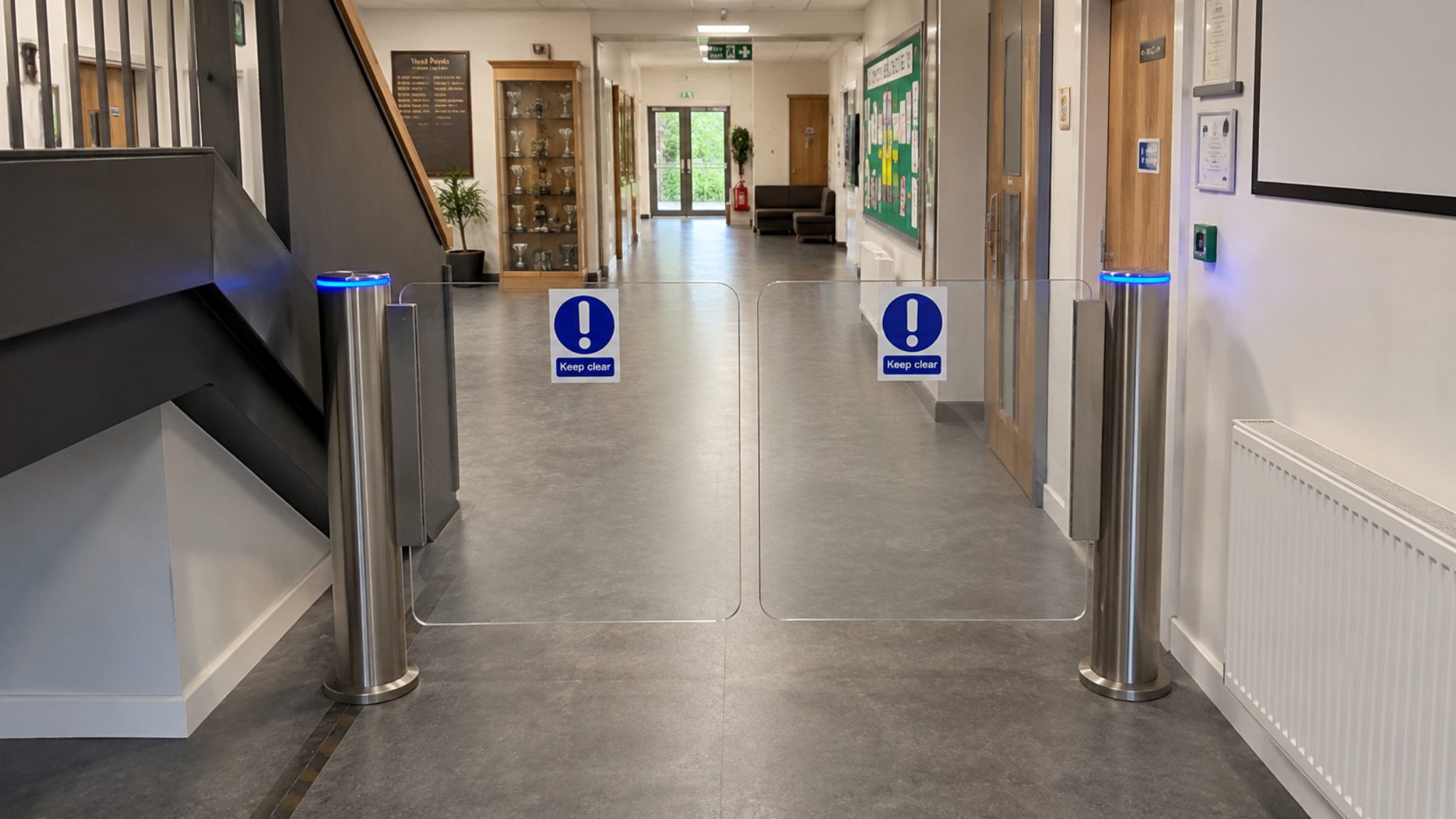
Once students, staff and visitors are inside a school building, access still needs to be managed carefully. Reception areas, teaching blocks, staff spaces and specialist facilities all have different access needs throughout the day.
Swing gates are often used in internal settings where full perimeter-style security is not needed, but movement still needs to be managed in a clear and structured way.
What are powered swing gates?
Powered swing gates are motorised pedestrian gates used to control movement between areas. They are usually integrated with an access control system and are designed to manage flow rather than act as a high-security barrier.
They are useful in areas where reliable access management is needed without the intensity of a full single lane speed gate installation.
Unlike single lane speed gates, which are designed for higher throughput and stronger control against tailgating, swing gates are more suited to guiding movement through internal spaces.
When swing gates make sense in schools
In schools, swing gates are most effective when the aim is to organise movement rather than restrict access completely.
They are often chosen where areas need to be separated without making the site feel overly restricted. They can help guide students and staff through specific routes during the day or allow certain spaces to be opened and closed depending on the time, activity or use of the area.
Swing gates can also be a practical option when budgets need to be balanced across several access points. In many cases, they support everyday site management rather than strict security boundaries.
That distinction matters because it affects where they should be used across the school.
Where schools typically use swing gates
In education environments, swing gates are usually installed inside buildings rather than on external boundaries. Some areas may include:
- Receptions, especially where visitor flow needs to be directed
- Sixth form centres, where students may need more independence while still benefiting from controlled access
- Staff areas, particularly in larger schools where safeguarding policies require clearer separation between public and private zones
- Sports facilities, as these spaces often operate on different schedules
- Libraries and learning resource centres, particularly where quieter or supervised spaces need to be maintained
In each of these settings, the purpose is not to lock areas down completely. It is to create clear boundaries that support safe, organised movement.
Swing gates versus single lane speed gates
Swing gates and single lane speed gates are sometimes compared, but they serve different roles.
Single lane speed gates are designed for higher-security environments. They are commonly used at main entrances or in areas where stricter access control is needed.
Swing gates are better suited to internal zoning and lower-intensity control points. They are typically used where schools need separation between areas and controlled closure of spaces, rather than maximum anti-tailgating protection.
Single lane speed gates are usually used to control entry into a building. Swing gates are used to manage movement within it.
Both can form part of the same access control system when planned correctly, but they should be specified for different reasons.
Integrating swing gates into school security
Swing gates should be considered as part of the overall school security setup, rather than as a standalone solution.
In schools, this usually means they sit alongside door access control systems, CCTV coverage and perimeter security measures.
Access control systems manage who can enter specific rooms or zones. CCTV provides visibility of movement across the site. Perimeter fencing and gates help secure the boundary. Swing gates then help manage internal flow once people are inside the building.
When these elements work together, schools gain a clearer structure for daily movement. It can also reduce the need for heavy physical barriers in every location, helping the site feel less restrictive.
Installation and ongoing support
When EA Group installs swing gates in a school environment, the first step is understanding how the site operates. Layout, safeguarding requirements and user flow all need to be considered before any equipment is specified.
The system should support existing routines rather than disrupt them. This includes looking at how students move between lessons, how staff access different areas and how visitors are guided through the site.
Once installed, ongoing support is important. Schools change over time through expansion, refurbishment or policy updates. Access control systems need to be able to adapt with them.
Swing gates offer flexibility for changing environments, particularly when they are part of a broader integrated system.
Are swing gates right for your school?
Swing gates are not designed to replace high-security systems. Their value lies in helping schools manage internal movement in a controlled and practical way.
When used correctly, swing gates can support smoother movement and help maintain clear separation between different parts of a school site.
At EA Group, we work with schools to identify where swing gates fit and how they can be integrated alongside other security systems to support safety and usability.
Contact the EA team today to discuss the right access control setup for your school.


