
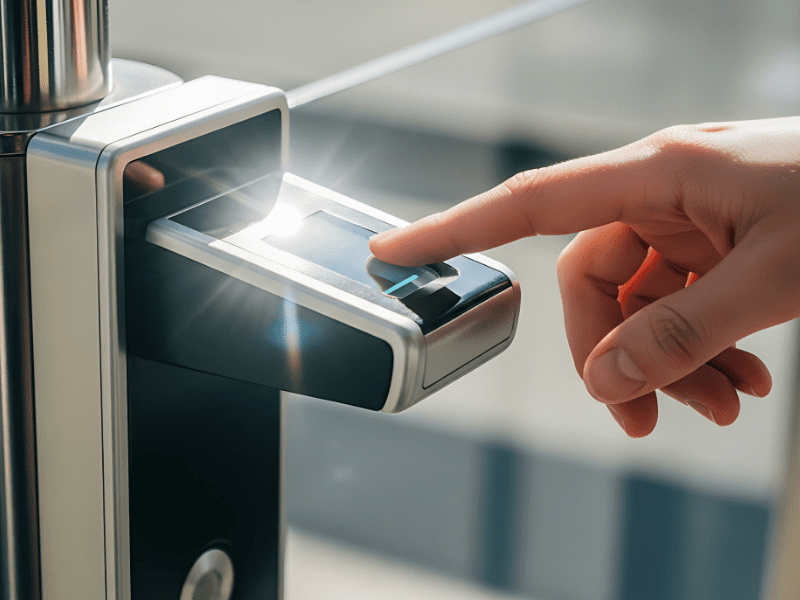
Single lane speed gates are used in busy entrances where access needs to be controlled without slowing people down. They are common in offices, education buildings, leisure facilities, transport settings and public buildings where large numbers of people move through the same entrance each day.
When biometric access control is added, single lane speed gates can verify who is entering, rather than relying only on cards, fobs or PINs. This gives the building a stronger layer of access control while keeping entry quick for authorised users.
What are single lane speed gates?
Single lane speed gates are access control gates that open once a valid credential has been presented. This could be a card, fob, PIN, mobile pass, biometric reader or another approved access method.
They are usually installed in reception areas, office lobbies, campuses and high-traffic entrances where security teams need better control over who can enter.
A good single lane speed gate layout gives users a clear route into the building, reduces pressure at busy times and helps prevent unauthorised access.
Where biometrics fit into access control
Biometric access control verifies a user through a physical feature, such as a fingerprint, face or iris.
With single lane speed gates, the biometric reader can replace or work alongside traditional credentials. Once the user is verified, the lane opens and allows them to pass through.
This is useful in buildings where identity needs to be checked more closely. Cards and fobs can be lost, borrowed or shared. PINs can be forgotten or passed on. Biometrics make it much harder for someone to enter using another person’s credentials.
Reducing credential misuse
Card-based access works well in many buildings, but it depends on users keeping their credentials secure.
If a card is lent to another person, lost or stolen, the system may still treat it as valid until the issue is reported. Biometric access reduces this risk by linking entry to the individual.
For sites with restricted areas, sensitive information, high-value equipment or large numbers of users, this can strengthen the wider access control strategy.
Faster entry for regular users
Biometrics can also make daily entry quicker, as staff, residents, students and approved visitors can move through the lane without searching for a card or typing in a PIN. This is useful during peak times when queues can build quickly.
Contactless options, such as facial or iris recognition, can also reduce the need to touch shared readers. This may be useful in offices, healthcare settings, education buildings and leisure facilities where speed, hygiene and convenience all matter.
Helping prevent tailgating
Tailgating is an issue that happens when an unauthorised person follows an authorised user through an access point.
Single lane speed gates help reduce this risk through sensors, controlled gate movement and alarm functions. When biometric verification is added, the system checks that the person entering matches the authorised user.
This gives reception and security teams better control, particularly in buildings where certain areas need tighter protection.
Where biometric single lane speed gates are useful
Biometric single lane speed gates can be used across a range of sites.
In office buildings, they can provide quick staff entry while keeping visitor access controlled.
In education settings, they can help manage access to campuses, libraries, accommodation and restricted areas.
In healthcare buildings, they can separate public areas from staff-only or sensitive spaces.
In high-security environments, such as data centres, government buildings and transport sites, biometric verification can provide stronger identity control than standard credentials alone.
The right setup depends on the building, the level of risk, the number of users and how people move through the space each day.
Privacy and data protection
Biometric access control needs to be planned carefully.
Organisations should be clear about why biometrics are being used, how the data will be stored, who can access it and what alternatives are available for users who cannot or do not want to use biometric entry.
Fallback options are important. A card, mobile pass or staff-assisted route can make the system more practical and accessible.
For projects involving biometrics, it is sensible to involve facilities, security, IT, HR and data protection teams early in the process. This helps make sure the system works for the building and the people using it.
Integration with wider security systems
Single lane speed gates and biometric readers work best as part of a wider access control system.
Depending on the site, this may include CCTV, visitor management, intercoms, building management systems or time and attendance software.
Integration gives building teams a clearer view of who is entering and helps avoid separate systems that become harder to manage over time.
EA Group can work with existing access control requirements or help specify a new entrance system for the site.
Choosing the right single lane speed gates setup for your business
The best setup depends on how your building is used. Important factors include footfall, peak entry times, security requirements, available space, accessibility, reader position, glass height, lane width and integration with existing systems.
A compact single lane speed gates may suit a smaller reception area. A high-glass single lane speed gates may be better where stronger physical control is needed. Multiple lanes may be required where large numbers of people enter at the same time.
Biometrics should be specified where there is a clear reason for stronger identity verification. The system needs to suit the building, the users and the level of control required.
Speak to EA Group about single lane speed gates and biometric access control
Single lane speed gates can help buildings manage access, improve pedestrian flow and create a more controlled entrance. When combined with biometric access control, they can also improve identity verification and reduce the risk of credential misuse.
EA Group designs, manufactures, installs and maintains single lane speed gates and access control systems for buildings across the UK.
Contact EA Group to discuss single lane speed gates, biometric readers and entrance security options for your site.


